MineCreator
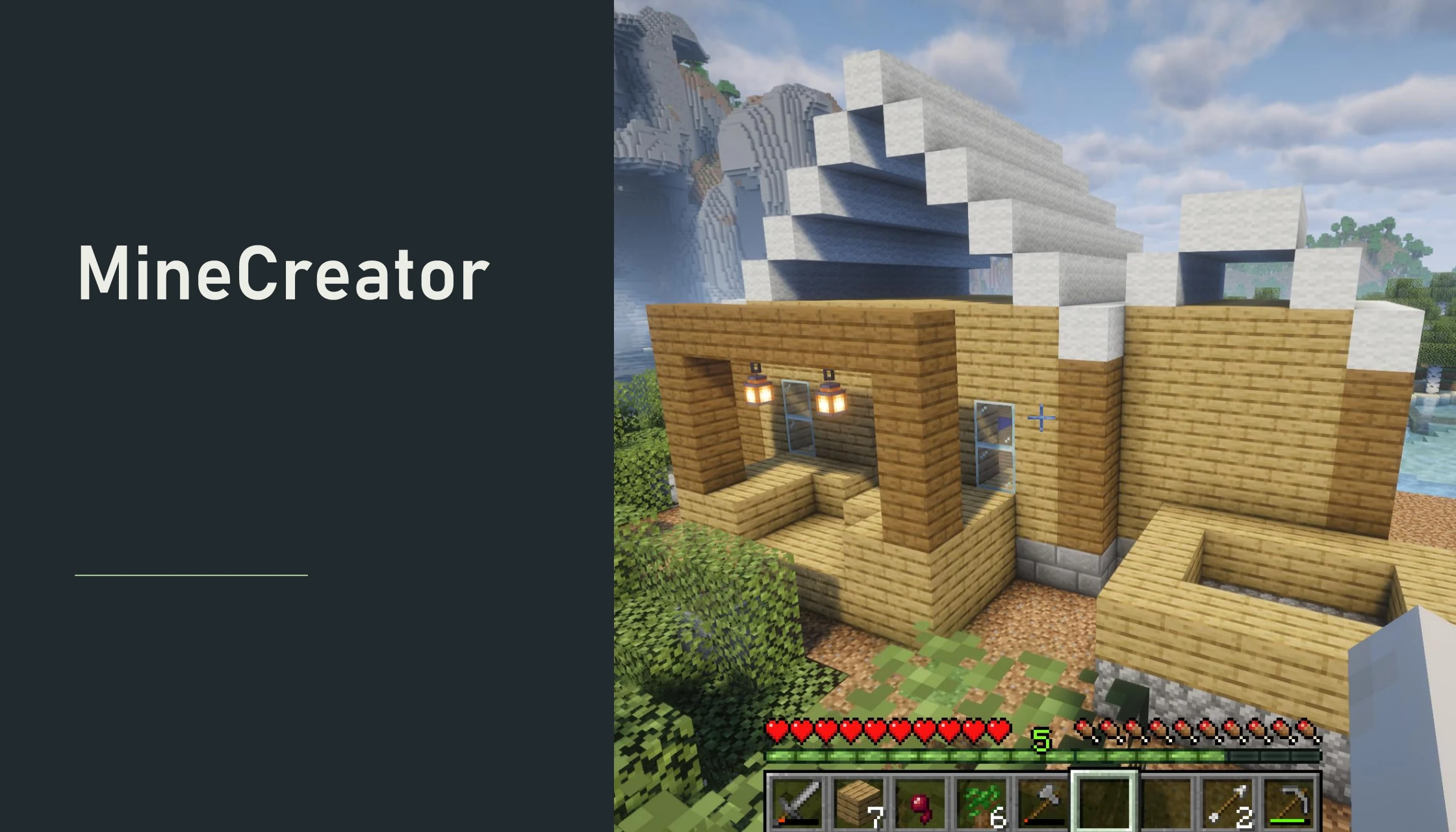
MineCreator is an LLM-powered tool for designing and building structures in Minecraft, developed with Python. I started it in October 2026, and I am the only developer. The project is still being refined and polished, and a demo will be released later.
View the GitHub repo
MineCreator — Project Pitch
Project Pitch
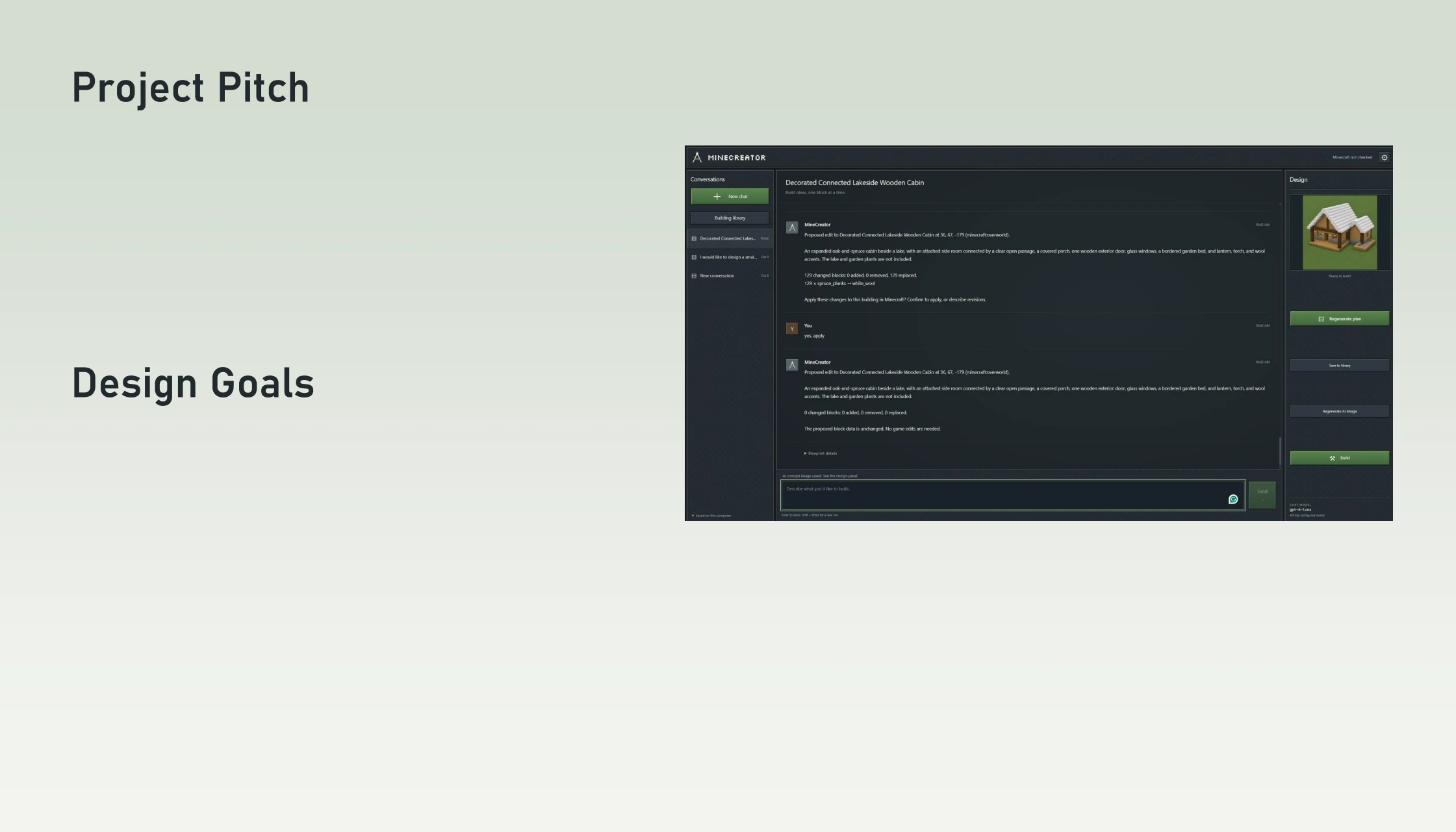
Building a good-looking house in Minecraft takes a lot of time and building experience, which many players do not have. MineCreator lets players describe the building they want in plain words, discuss it with an LLM, check a preview, and then watch it being built block by block in their own world. The target users are players who enjoy building but want help with design and the repetitive work.
Design Goals
Easy to use: after a one-time setup, everything is done in the GUI, and no commands need to be typed.
Vanilla saves: only vanilla blocks are used, so the world still opens in normal Minecraft without any mods.
Visible building: the building appears stage by stage, so players can watch it grow instead of seeing it appear all at once.
Player safety: the site is chosen away from the player, and suitable natural terrain nearby is preferred.
The main window of MineCreator
MineCreator — How It Works
How It Works
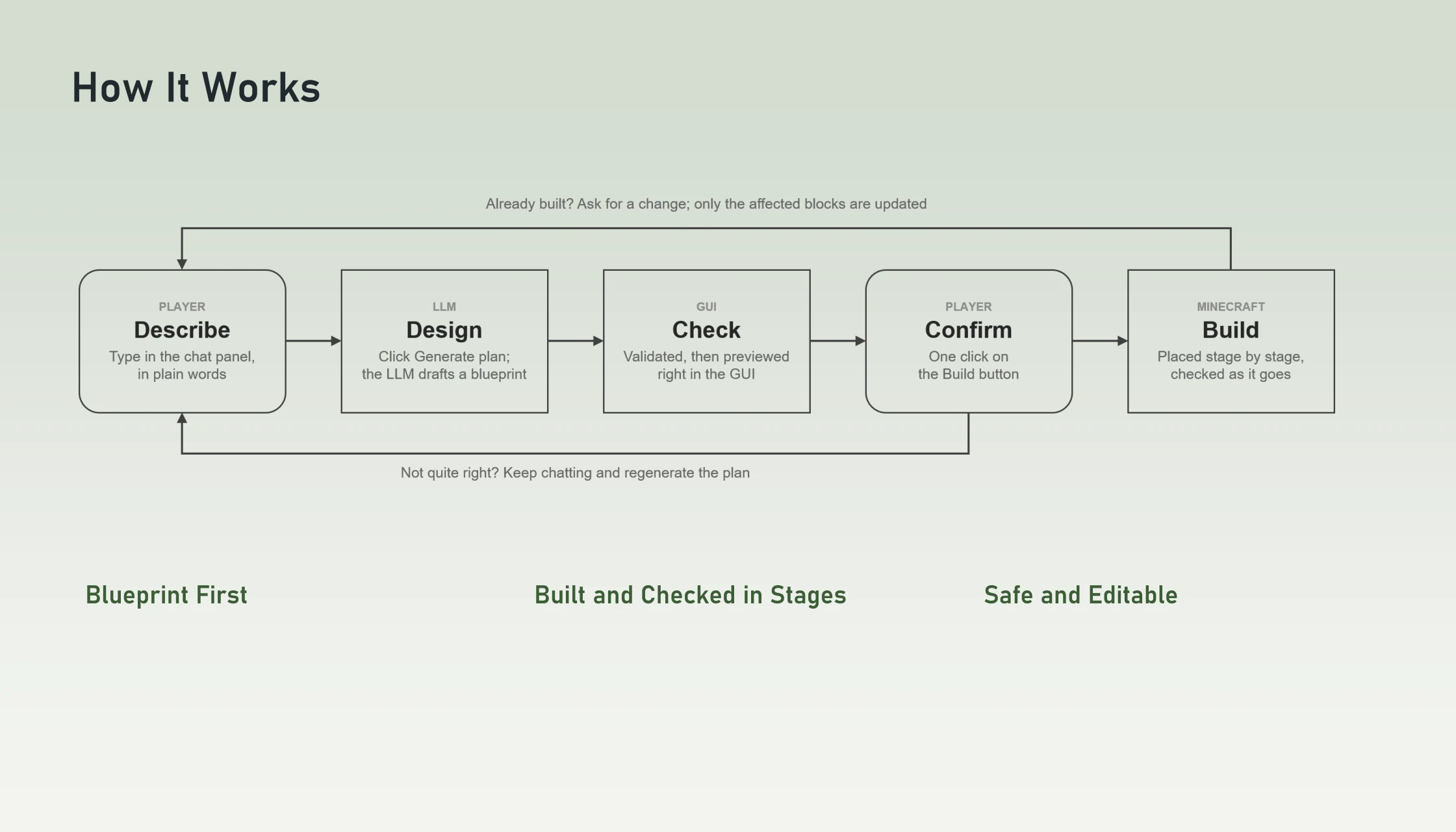
Blueprint First
The LLM does not touch the game directly. It writes a structured blueprint, and the program checks it against strict rules before anything is built.
Built and Checked in Stages
Blocks are placed stage by stage through Fabric and the MCPFabric mod. After each stage, the program reads the blocks back from the game and stops if something does not match.
Safe and Editable
Before building, MineCreator looks nearby for a suitable site and keeps clear of the player. Changes asked for in chat later only update the affected blocks.
MineCreator — GUI
GUI
For the GUI, I designed and implemented:
Multi-turn chat in Chinese or English, with saved conversations
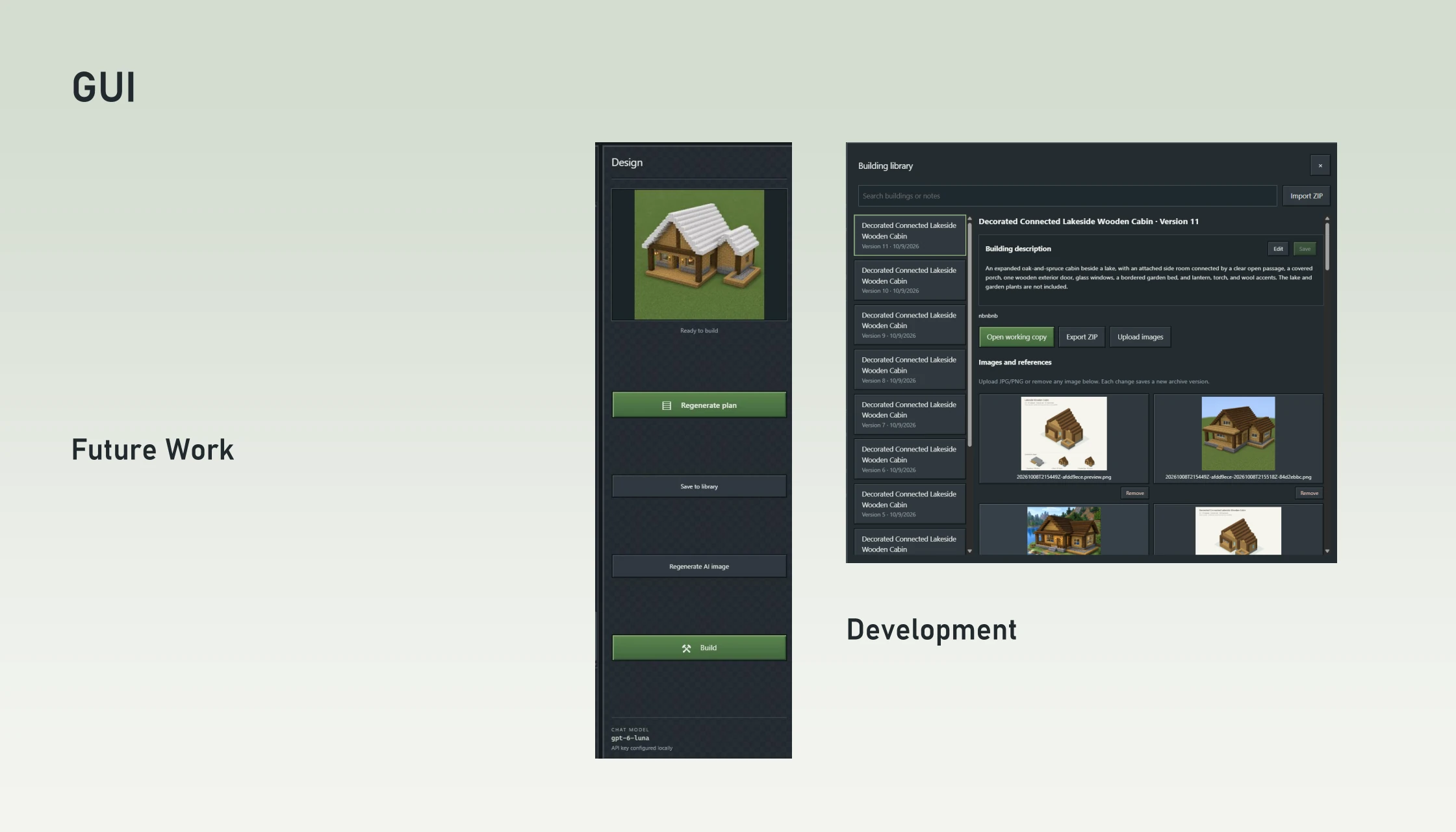
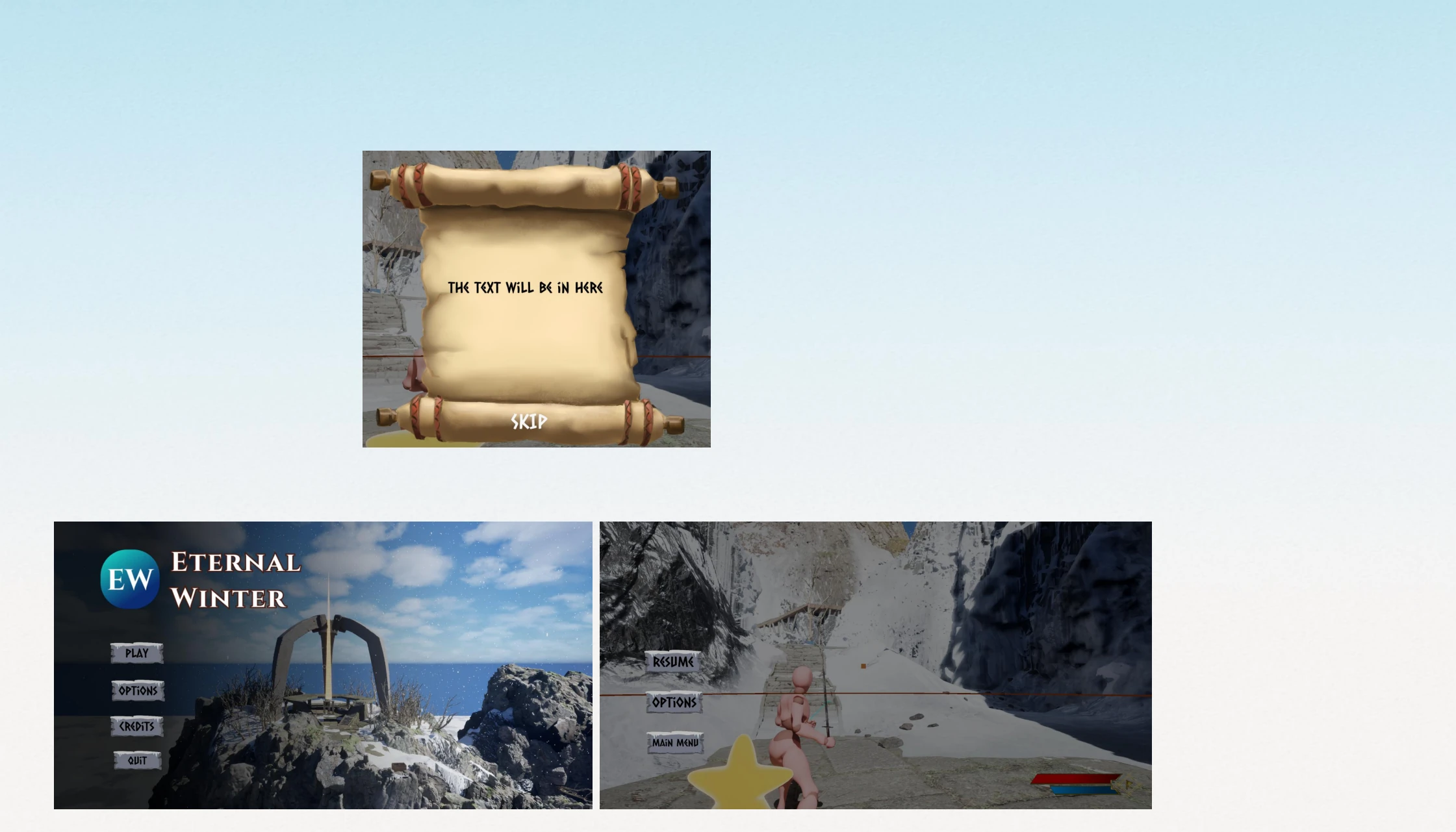
Generate plan, Build and AI image buttons in the Design panel
A block preview of the blueprint before building
Build progress and reviewed edits shown in the chat
A building library with versions, notes, images and ZIP export
Settings for the API key, model and Minecraft folder
Future Work
MineCreator is still being refined. In the next iteration, I plan to support more building shapes and details, so that the finished buildings look closer to the concept images. I will also finish testing the Windows app and record a demo video.
Design panel
Building library
Development
MineCreator is written in Python, with a local web-based GUI. It connects to Minecraft through Fabric and the MCPFabric mod, and uses the OpenAI API for chat, blueprints and preview images. Automated tests cover the main workflows and failure cases, such as a lost game connection.
Games
Eternal Winter
Eternal Winter — Introduction
Eternal
Winter
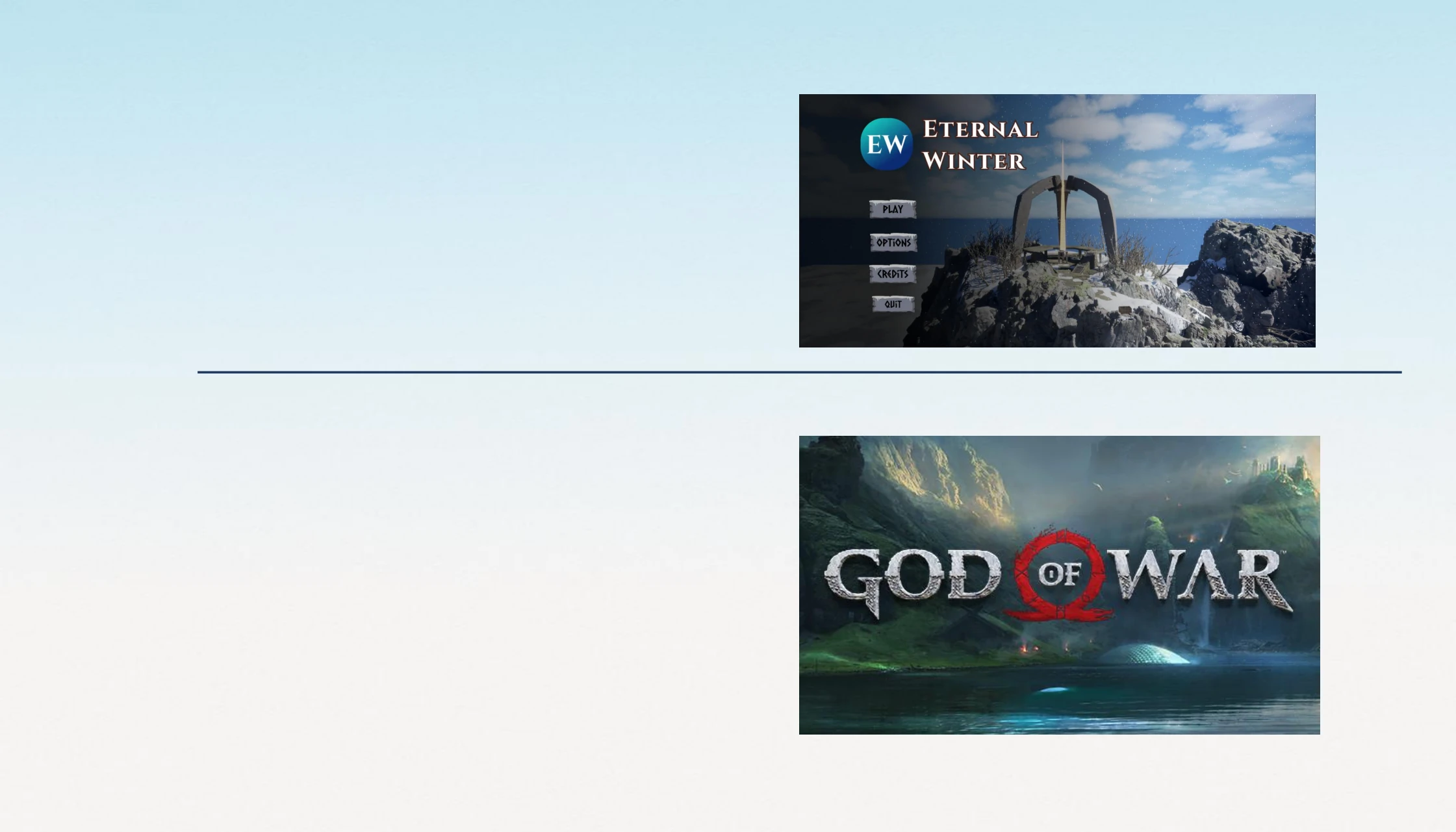
Eternal Winter is a UE5 action-adventure game developed by the SMSU team at MSU and Sony Santa Monica Studio in Spring 2025. I was a programmer on the team.
Watch the Demo
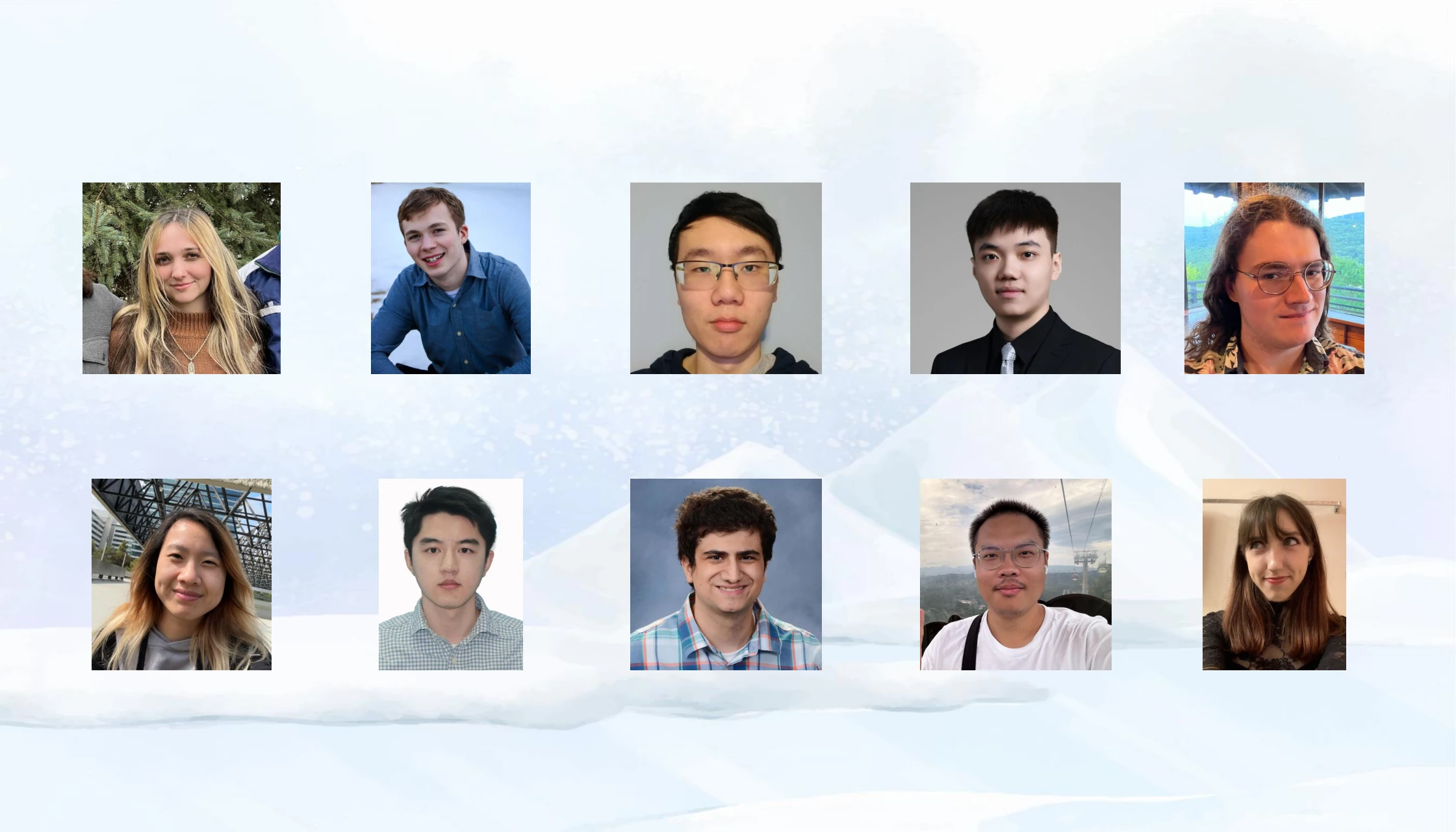
Eternal Winter — SMSU Team
SMSU Team
Cameron Otten
Lead Programmer
Sydney Gossage
Concept/2D Artist
Ryan Chang
Programmer
Travis/Tianjian He
System Designer
Xunzhuo/Noah Zhang
Programmer
Claire Oselador (Sony)
Composer
Cat Start
Producer
Maher Fawaz
Gameplay/UI Designer
Qixuan/Mark Huang
Level/Narrative Designer
Yixi Knapp
3D Artist
Eternal Winter — Project Pitch
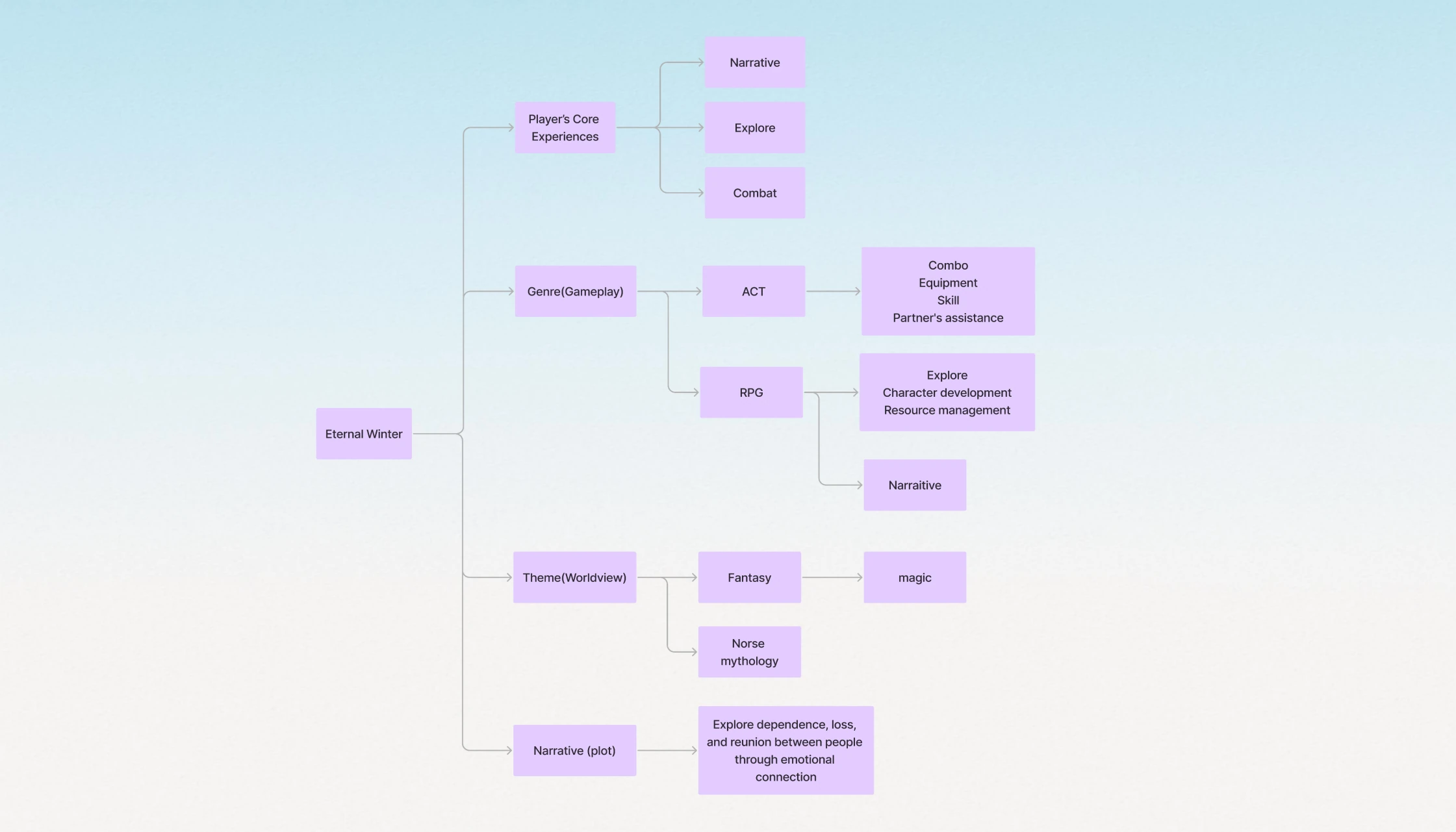
Eternal Winter is a third person action-adventure set in a fantastical world where players ascend a snowy mountain to save their village from eternal winter. Featuring realistic art, diverse enemies, and a compelling narrative shaped by exploration and action, our target audience is adult gamers who enjoy single-player experiences.
Project Pitch
Inspirations
As a project developed in collaboration with Sony Santa Monica Studio, our game is mainly inspired by God of War. We referenced God of War's design in gameplay, level design, art design and narrative.
Eternal Winter — System, AI and Combat
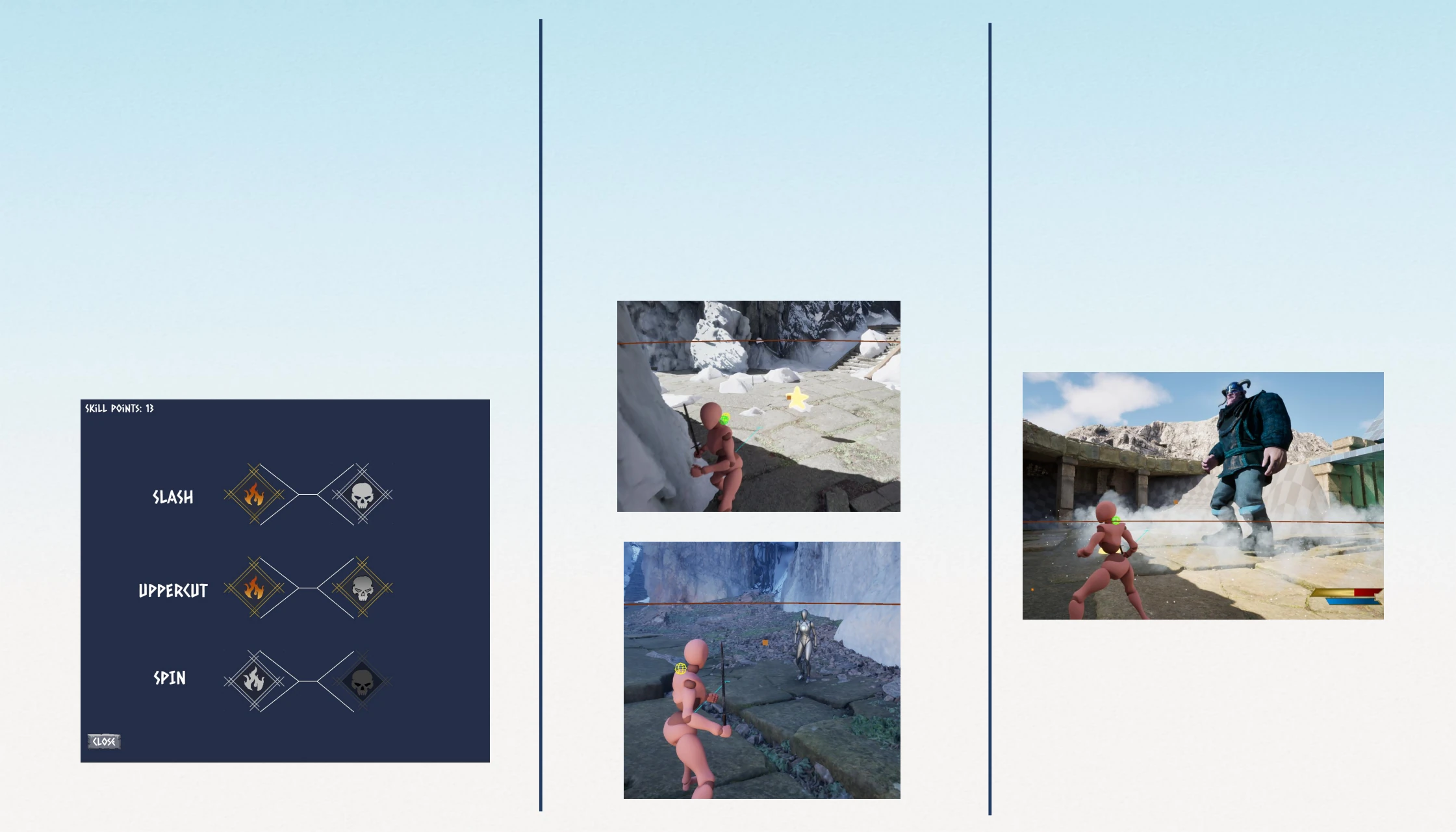
The magic system in Eternal Winter allows players to learn new magic. Skills are divided into two types, "Fire Skills" and "Dark Skills", which can improve different attributes of the player. Unlocking skills costs skill points, which can be earned by killing enemies, picking up items, etc.
System
AI
Combat
Our enemies, Boss and Wisp use AI technology. They can detect the player's position and automatically perform corresponding interactions.
Players can attack enemies with melee attacks. Different types of enemies can damage the player by melee attacks, shooting, and AOE skills cast by the Boss. The Wisp can also freeze enemies for a short time.
Eternal Winter — Abstract
Abstract
Eternal Winter — Design
Design
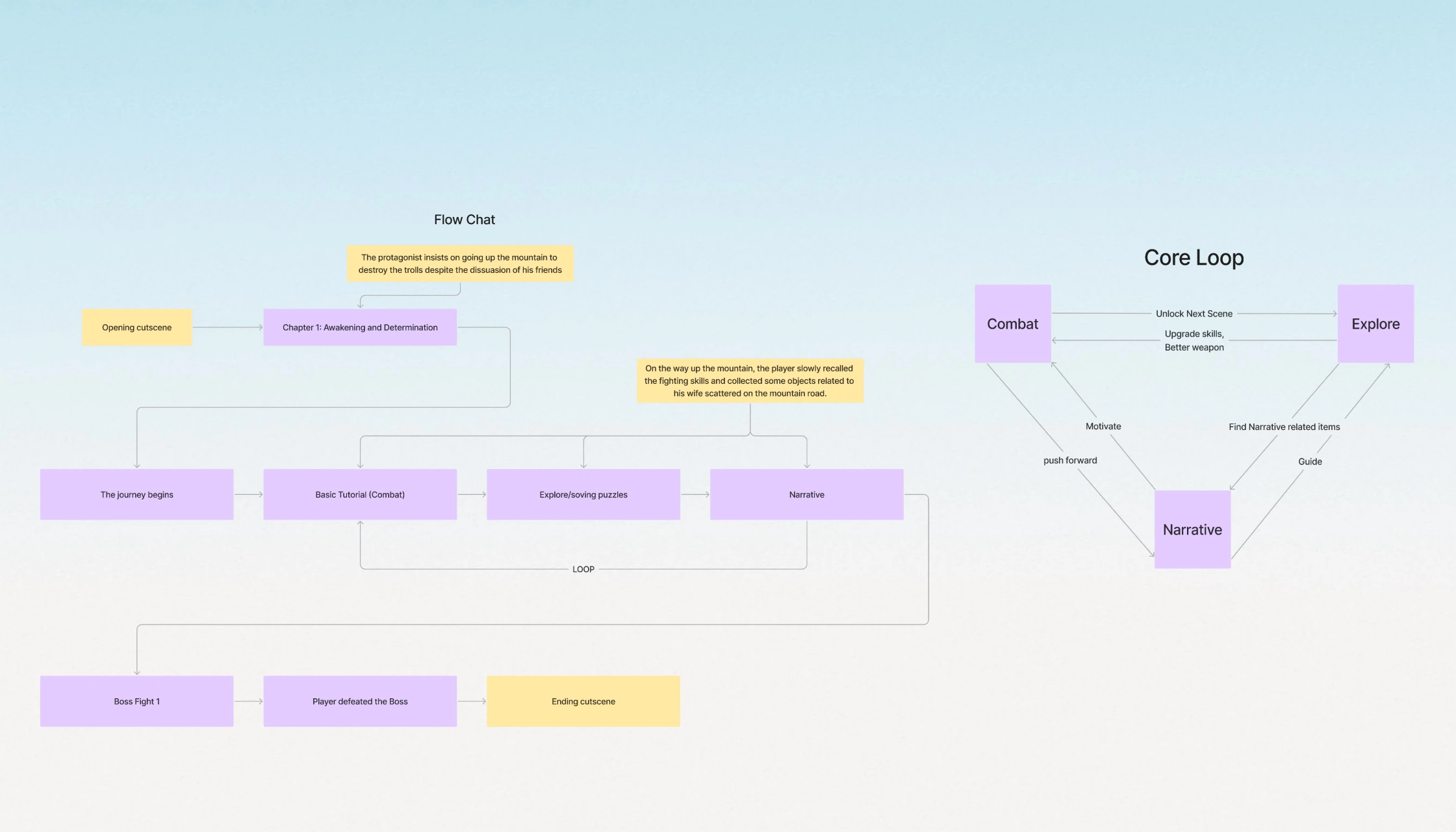
Game Flow
Core Loop
Eternal Winter — Art Design
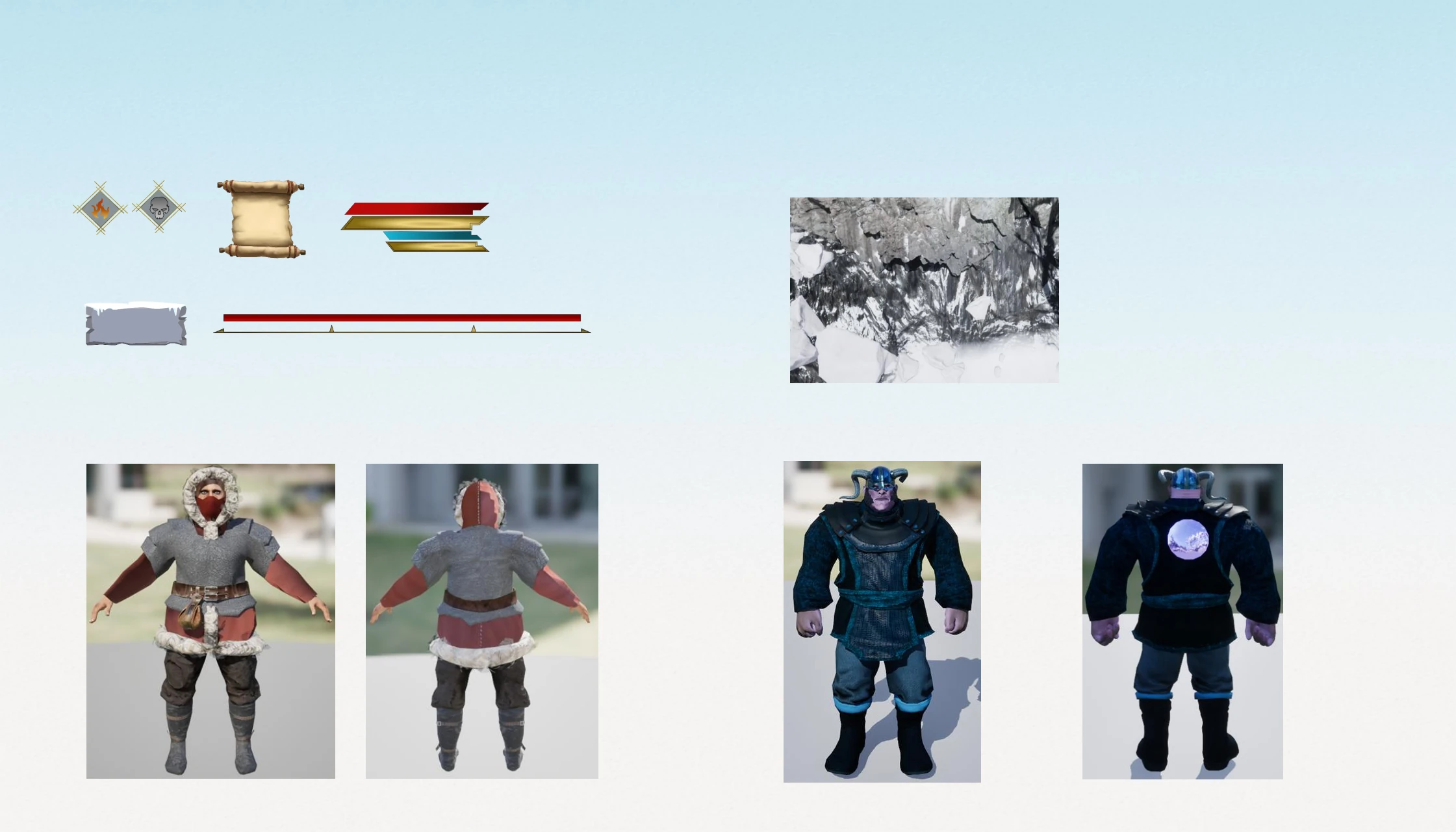
Art Design
Main Character
Boss
Environment
UI
Health Bar
Info Panel
Skill Icons
Menu Button
Boss Health Bar
Eternal Winter — Level Design
.
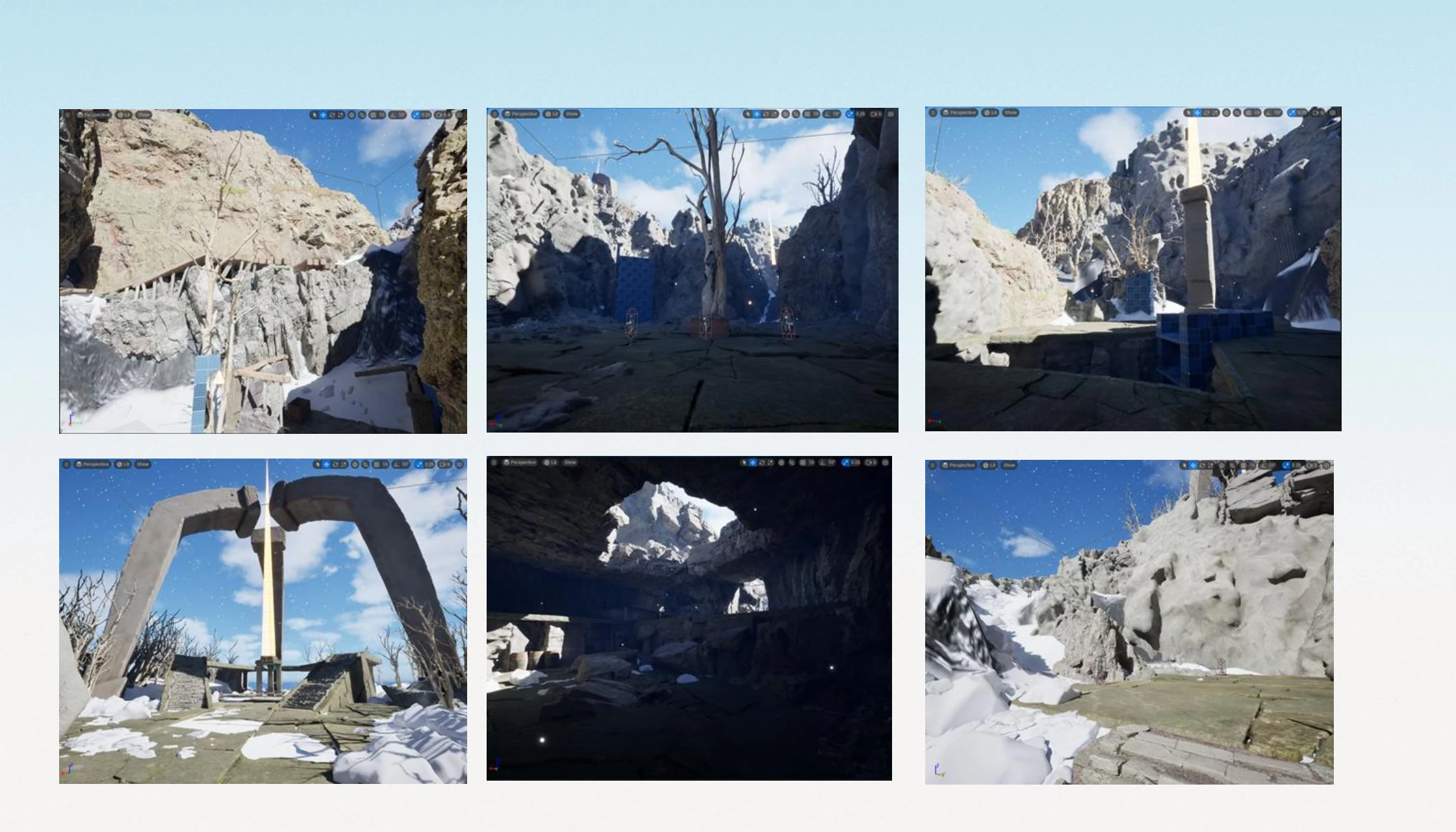
Level Design
1
2
3
6
5
4
Eternal Winter — My Work
My Work
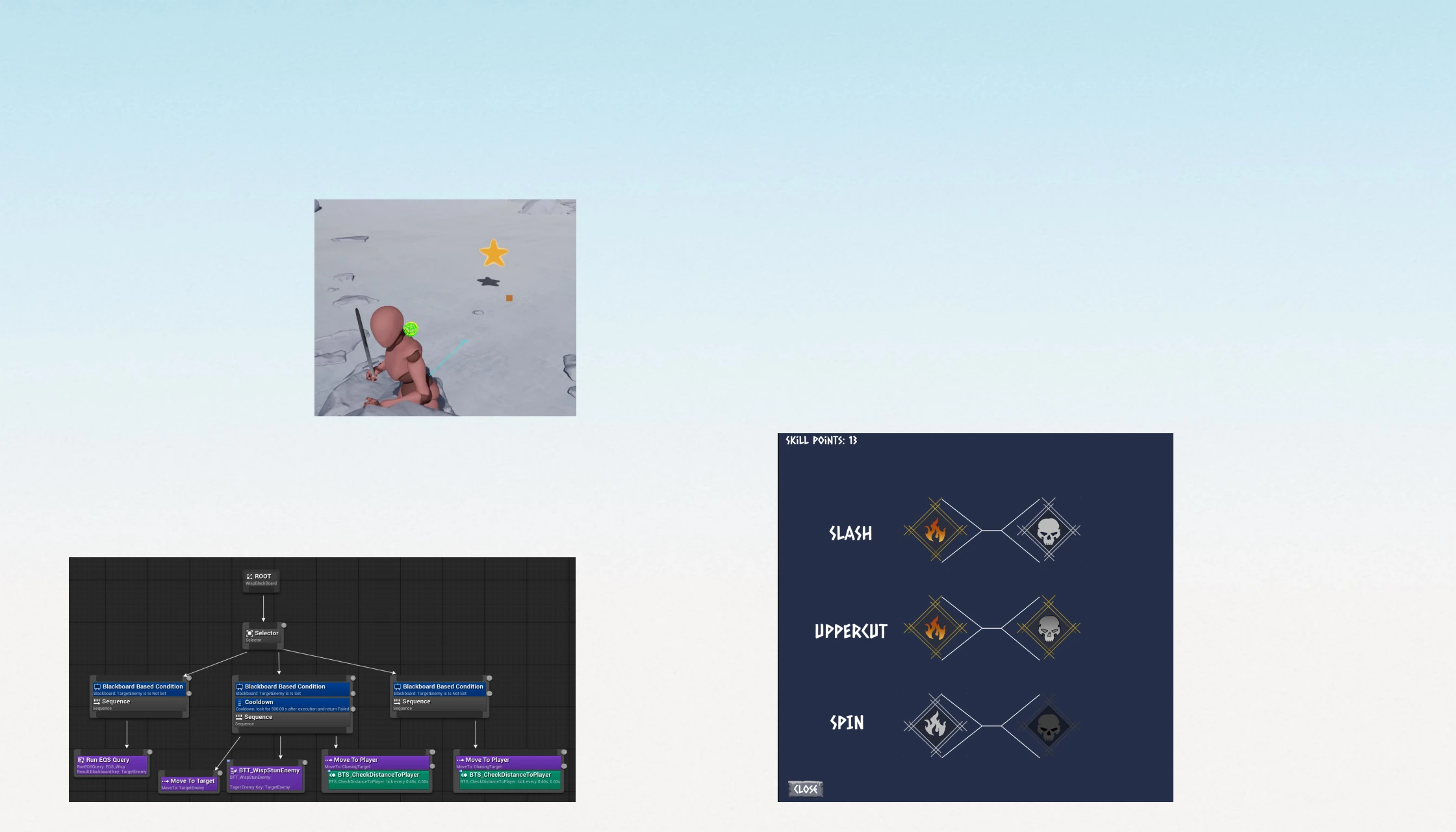
Wisp
Skill Tree
For the Wisp, I implemented:
Auto-follow the player
Detect nearby enemies
Select and fly to the nearest enemy
Briefly freeze enemies
Return to the player after the enemy dies
Fly back if too far away
Guide the player forward in specific areas
For the skill tree, I developed and implemented:
Button functions for each skill (click to activate skills)
Unlock order between skills
Adding/subtracting skill points
Saving skill evolution state
Button appearance changes with the skill's current state
Show skill info when the mouse hovers
Eternal Winter — UI and Other Contributions
UI
For UI, I developed and implemented:
Switching between screens
Start, pause and quit the game
Skill tree UI screen
Health bar changes with HP
Skill tree UI implementation
Volume adjustment
Saving current game progress
Adding/subtracting skill points
Saving skill evolution state
Button appearance changes with the skill's current state
*Show skill info when the mouse hovers
Others
Developed pickup items in the map.
Assisted in developing character actions and animation
Truth Behind the Fake
Truth Behind the Fake — Introduction
Truth Behind the Fake
Truth Behind the Fake is a 2D side-scrolling game developed with Unity. I have developed it intermittently since October 2024, and I am the only developer of the game. A redesign of the overall game is planned, so this work may change a lot in future versions.
Watch the demo
Truth Behind the Fake — Core Gameplay
Core Gameplay
In Truth Behind the Fake, players play as a cyber detective. They control the protagonist to explore the map, defeat enemies and collect the evidence in each level to pass it, and win the game after defeating the Boss in the final level.
Narrative Design
Inspiration
The player attacks the enemies in front by swinging a long sword. The player takes damage when their body touches an enemy.
Combat Design
The game tells the story of a cyber detective who is entrusted by the administrator of the online community "GreenHome" to investigate the source of the misinformation that recently appeared in large amounts in the community. The villain of the game is the CEO of an oil company, who planned this misinformation attack because of GreenHome's environmentalist stance.
Enemy Types:
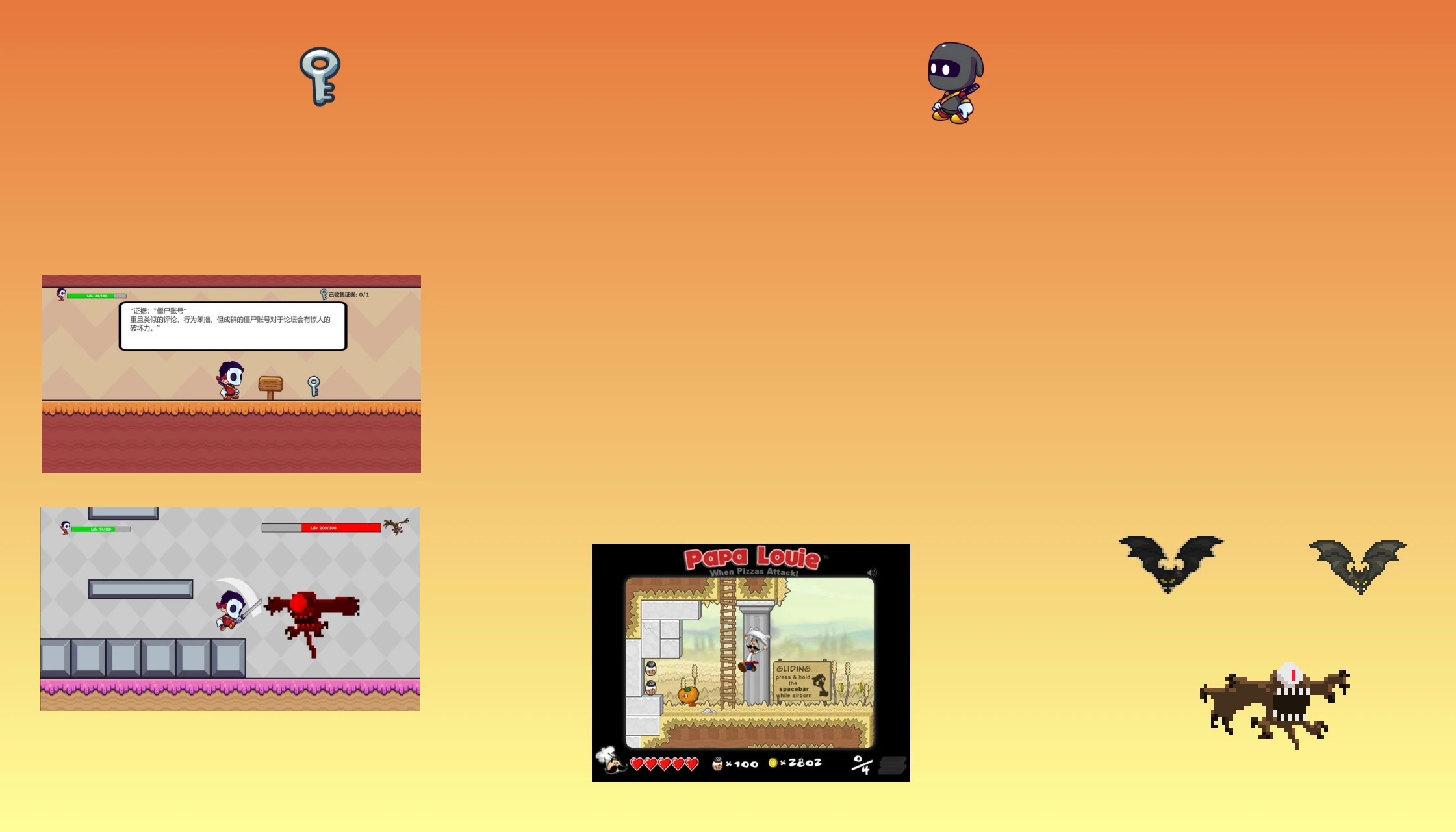
"Zombie Account": the most common low-level enemy. It can only patrol back and forth along a fixed route.
"Cyberbully": can actively chase the player, harder to deal with than "Zombie Account".
"Opinion Manipulation Team": the boss of the final level. It can not only actively chase the player, but also has a larger body and very high HP.
"Zombie Account" "Cyberbully"
"Opinion Manipulation Team"
The game was influenced by an earlier 2D side-scrolling game, Papa Louie: When Pizzas Attack!. Its design of attacking with a big hammer and collecting pizzas in each level to pass it was an important reference when I designed the gameplay mechanics.
Serious Game
Truth Behind the Fake is a serious game that is not purely for entertainment. The goal of the game is to educate players about misinformation on online forums through gameplay, and to improve their ability to deal with misinformation.
The target audience of the game is mainly college students who often use online forums. Because this group is young and active on all kinds of online forums, they are more likely to be affected by problems like misinformation online. At the same time, this group is more open to games, so they are the most likely to experience this product.
Target Audience
Design References
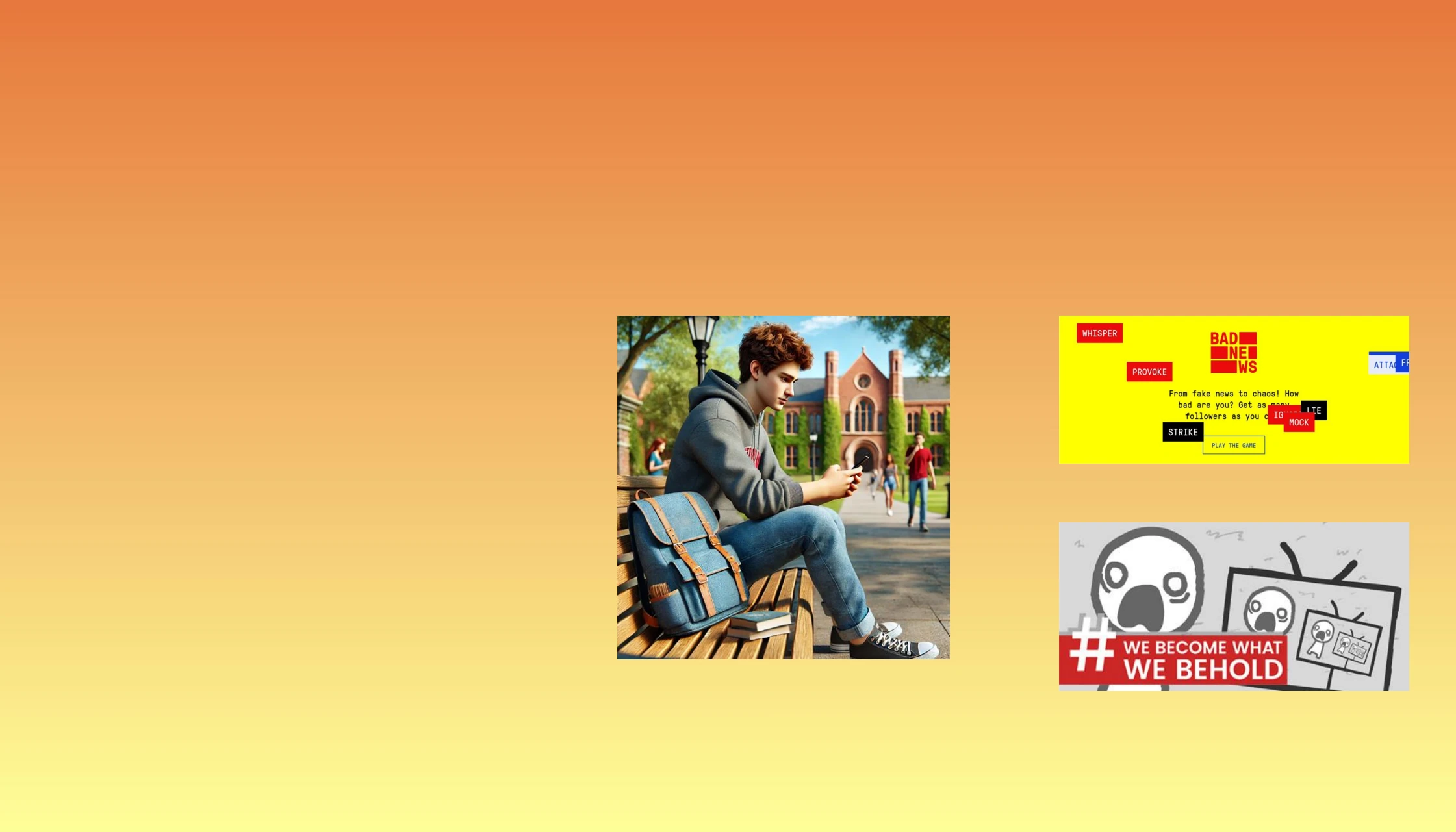
For the serious game design, Truth Behind the Fake mainly referenced the following two serious games: Bad News and We Become What We Behold. Both of them are representative works of serious games about misinformation and news.
A representative of the target audience of Truth Behind the Fake (generated by ChatGPT)
Future Work
In the next iteration, I plan to redesign the level design, actions and story of the game. The new version will be more playable than the current one, and will add a lot of new content and innovative designs, such as brand-new map structures and new types of monsters.
Also, as a serious game, I plan to show the knowledge that players are expected to learn in a more direct way. After the iteration is finished, I will recruit testers to run user tests, to check whether the game can effectively achieve its design goals.
Escape the Fantasy
Escape the Fantasy — Introduction
Escape the Fantasy is a 2D side-scrolling game. I developed it independently with Unity. Its biggest highlight is that the character can switch between two modes: flying mode and walking mode. The two different modes have different operating methods and paths. This can bring a unique experience different from the traditional side-scrolling game.
Click to watch the demo
Escape the Fantasy — Core Mechanics
Core mechanics
01
02
The player needs to control the character in the game. Avoid different kinds of traps through operations such as jumping. Meanwhile, make clever use of two different modes to reach the endpoint of the level.
Inspiration
The inspiration first came from my reflections on traditional side-scrolling games. I have always felt that the basic operations of this type of game are mostly character walking, running, and jumping, which lacks new ideas. One day, it suddenly occurred to me that if characters could freely choose to fly and walk in this type of game, it would bring a different experience to the players. So, the idea of making this game came about.
Game Mechanics
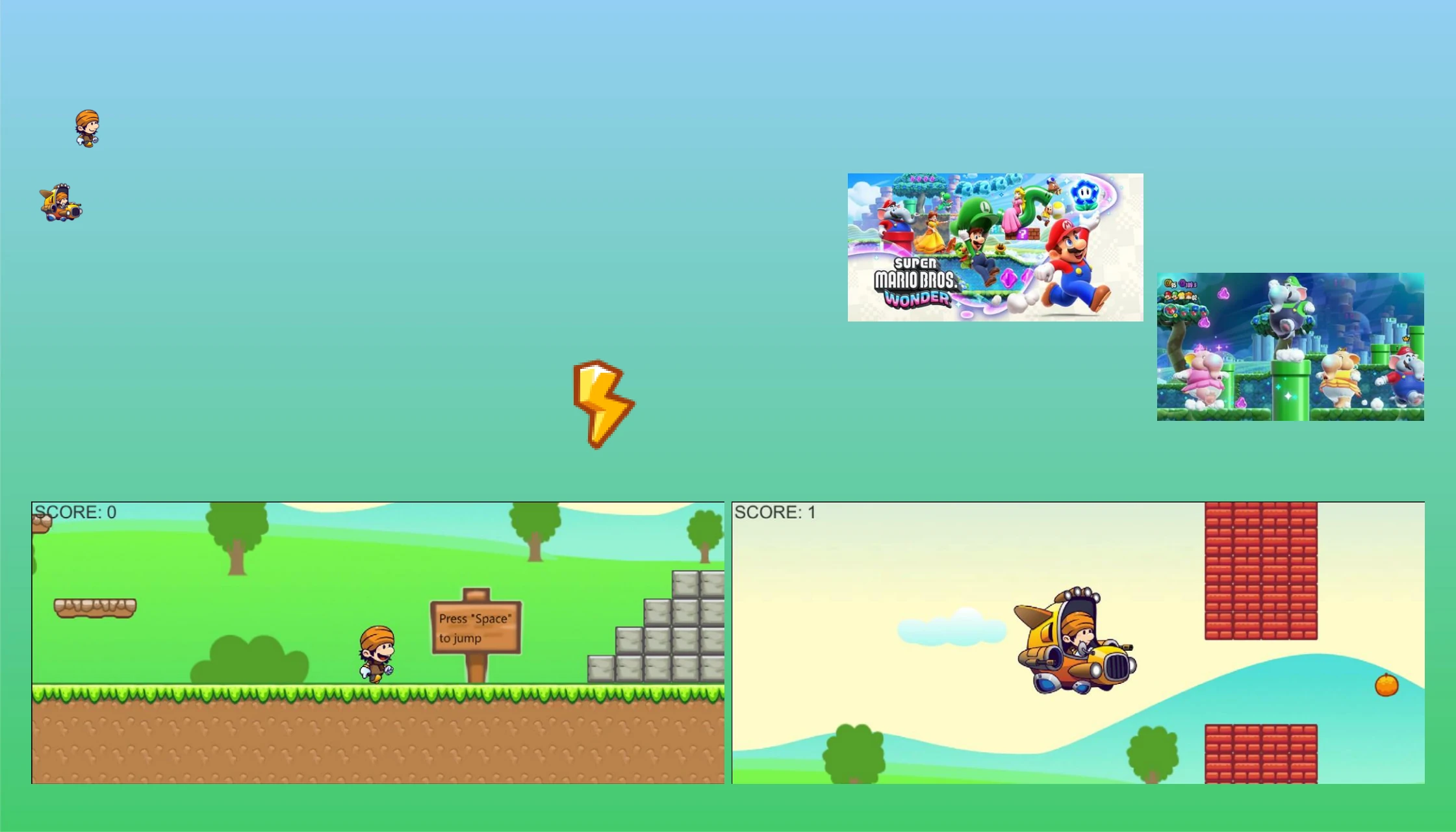
01 - The play mode will be switched when the player touches the transformer item.
02 - Walking mode: The player can walk and jump on the ground by pressing the space bar. In this mode, the player is affected by regular gravity.
03 - Flying mode: The player will float at a specific height in the air. When the W or S key is pressed, the player's aircraft will dive up or down for a certain distance and then fall back to the original floating height. The aircraft can dive up or down only when it is at its original height.
I reviewed some side-scrolling games with similar flying functions, to figure out how to design the player's control mode and what kind of game experience the flying mode should bring to players.
For the mode-switching mechanics, I mainly reviewed Super Mario Bros. Wonder. This game allows players to use different control modes, such as turning into an elephant. Its gameplay design is an important reference for the game I planned to make, so I mainly studied how this game expands the level design and gameplay experience through different control modes.
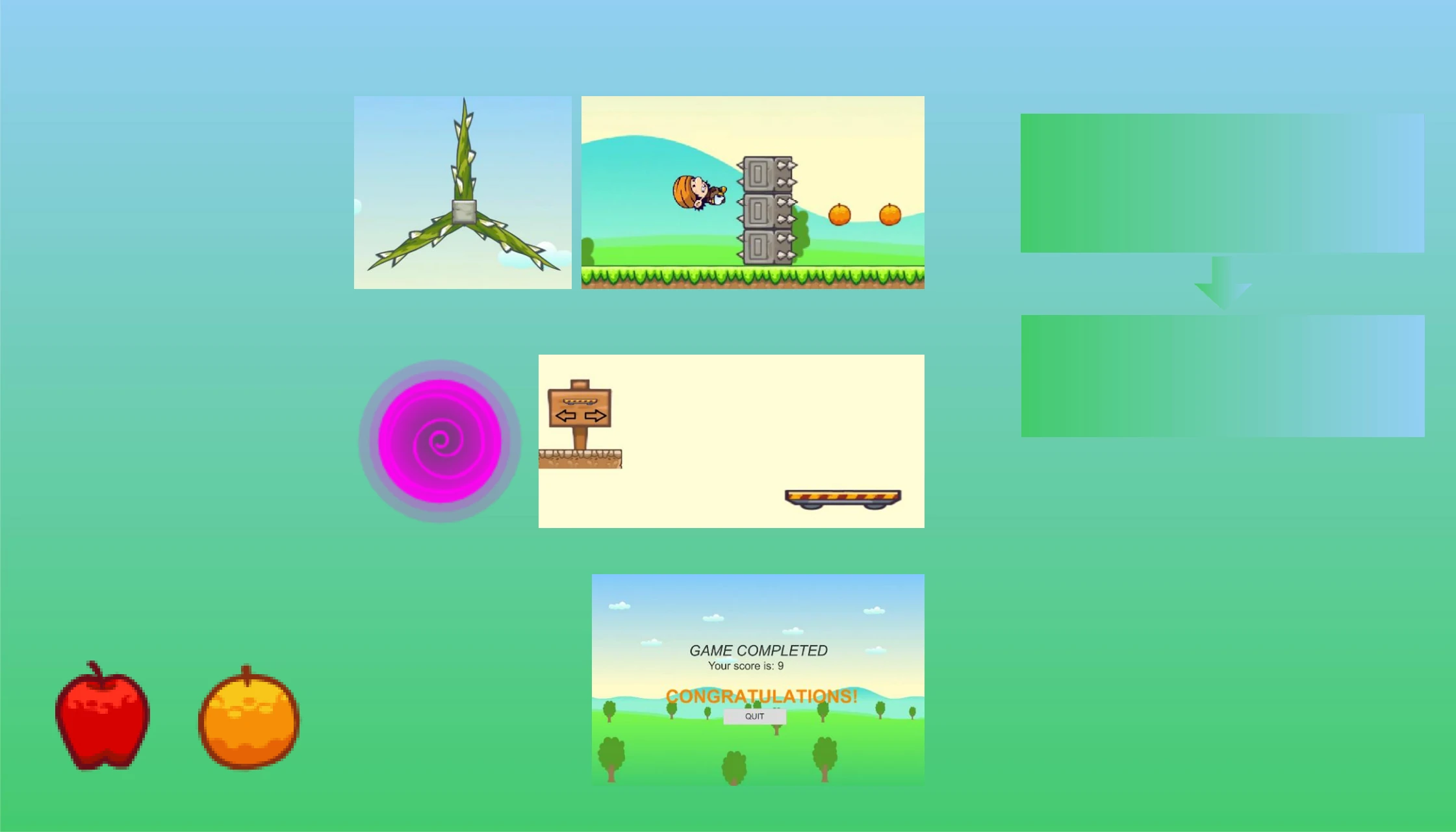
Item Collections: Players need to collect as many oranges, apples, and other bonus items as possible to gain higher scores. In the last level, players need to collect three keys scattered in the level to finally pass the game.
Research
Escape the Fantasy — Level Design (1)
Level Design (1)
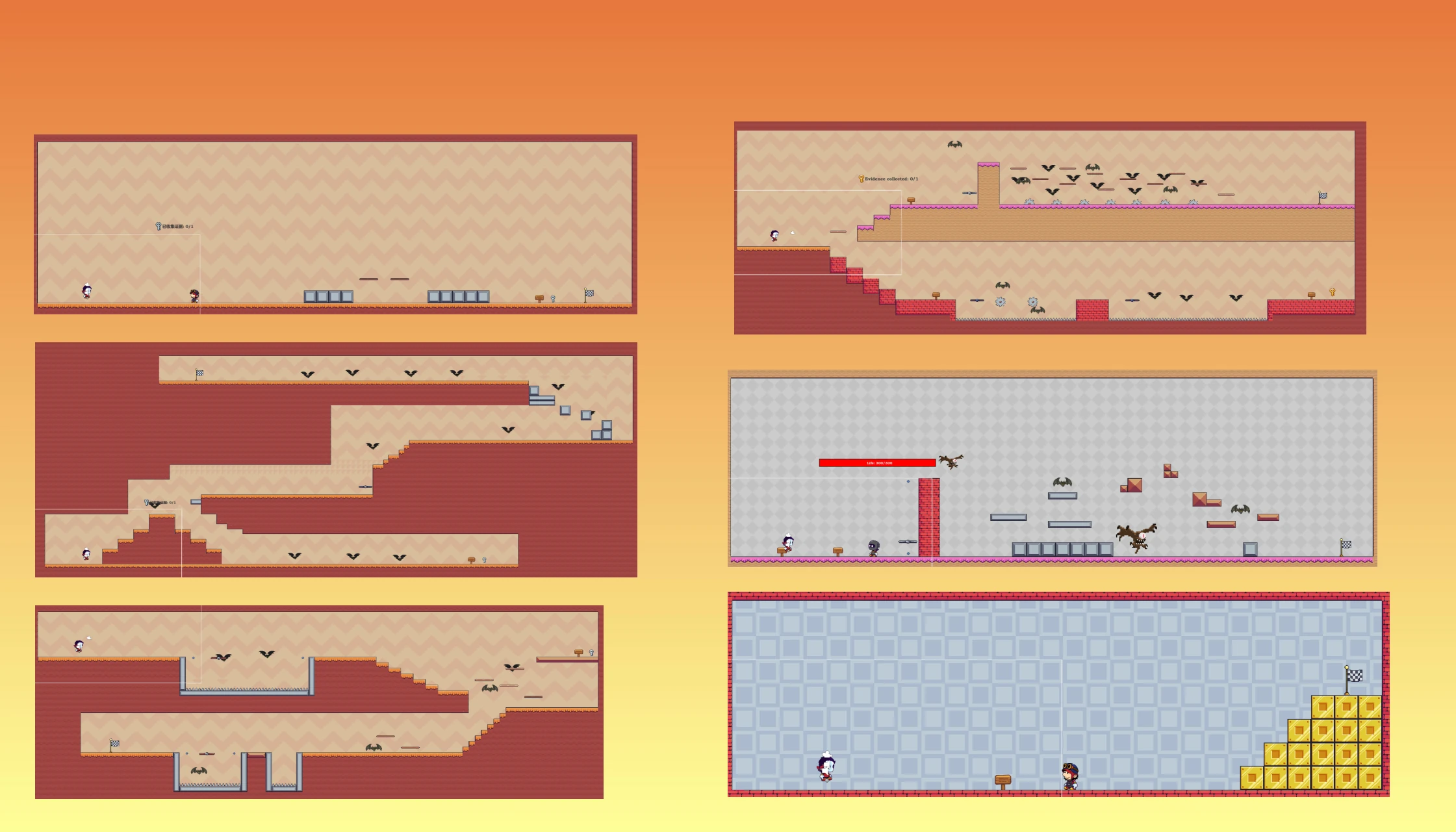
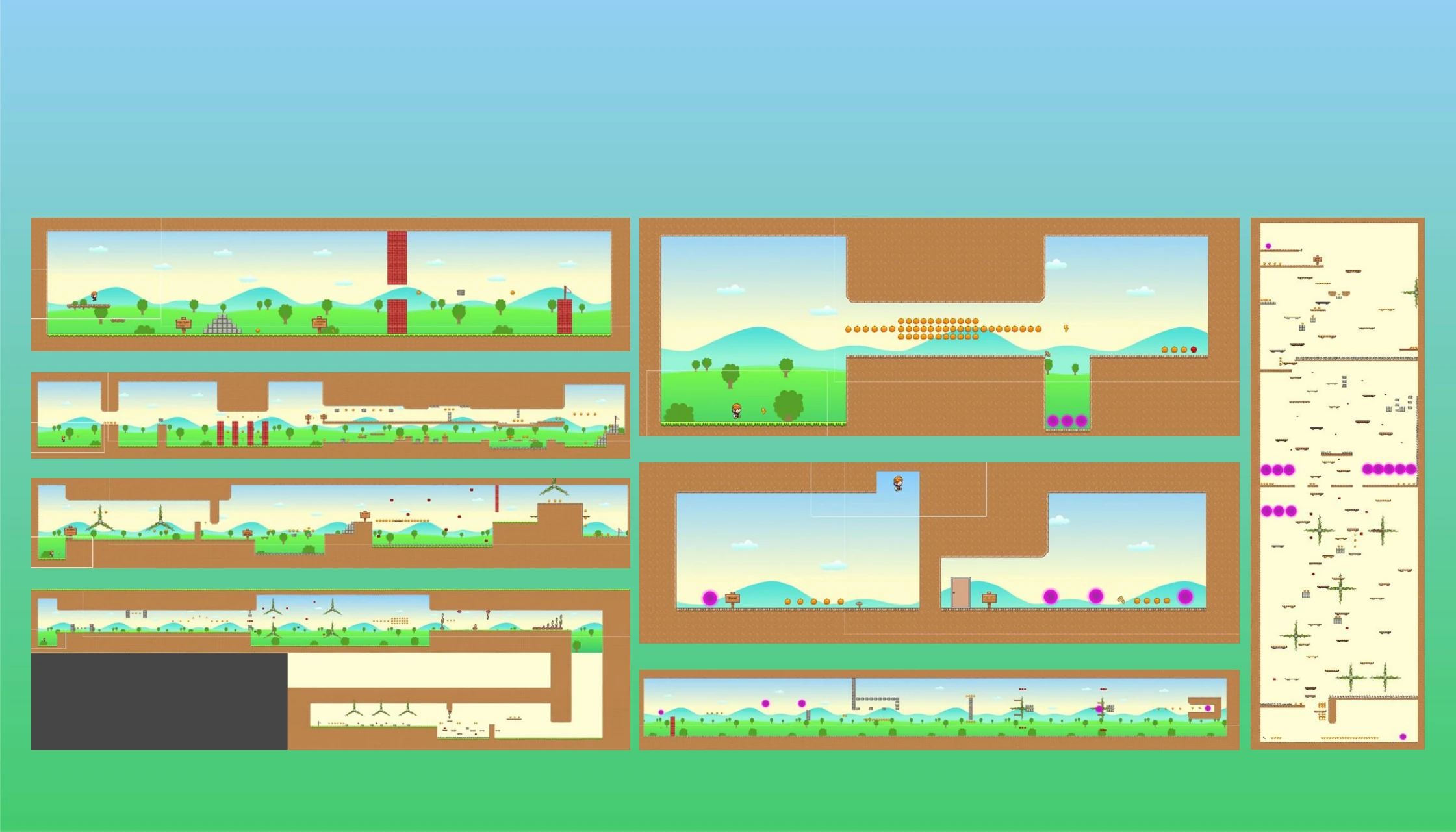
There are 6 levels in total. The levels gradually become more difficult, and level 2-0 is a bonus level that works as a connecting level.
Level 1-0
Level 2-0
Level 2-1a
Level 2-1b
Level 2-1c
Level 1-1
Level 1-2
Level 1-3
Levels are designed to follow the player’s flow curve. The difficulty of Levels 1-0 and 1-1 is low, and players will pass the level with a relatively relaxed experience. Levels 1-2 and 1-3 are hard and players may need to try several times to finally reach the end.
Level 2-0 is a bonus level for players to relax briefly. Level 2-1 is a compound level. Players need to pass two sub-levels in a row to pass the level. Level 2-1 is very difficult, and the player may need many attempts to finally pass it. After passing this level, the player's flow curve will also reach its peak.
Escape the Fantasy — Level Design (2)
Traps: There are various traps on the map, including spikes, rotating traps, telescopic vines, floating bombs, etc. If the player touches them, it will directly lead to death and the restart of the level.
Special Structures: There are some special structures on the levels, such as moving platforms and portals. Players can use them to get over obstacles and move forward in the level. Some portals are also traps: touching them will teleport the player back to the starting point of the level.
Reward Items: There are bonus items that can be picked up throughout the levels. Players will get scores when picking them up. At the same time, the more valuable apples are placed in dangerous, difficult-to-reach places, as a reward for players who take risks.
End:
Level Design (2)
I invited several of my college classmates to test it out, and they provided valuable feedback on my level design. I changed many design details based on the test results. Interestingly, they generally spoke highly of the difficult design of level 2-1, which was somewhat beyond my expectations. It seems that this level design indeed brought players a challenging and good game experience.
Future Development
In the future, I hope to further improve some details of the game, such as the smoothness of the controls. I will also try to add more creative level mechanics to bring players more novelty and a better game experience.
Iteration
This game has gone through one major iteration.
In version 1.0, the two sub-levels in level 2-1 are two independent levels, 2-1 and 2-2. But the experience brought by this design is not very good. The design of the entire game lacks novelty and is highly repetitive with previous levels.
As a result, I redesigned level 2-1 as a compound level in version 2.0. This design brings change and freshness to the player's experience, and helps push the player's flow experience to its peak.
Player Test
Cyber Paradise
Cyber Paradise — Introduction
Cyber Paradise is a plot-puzzle card game developed with Unity by our team "Cognition Boundary" in the Tencent Timi Studio x Third Building Cup University Game Jam in April 2023. I served as the deputy director and chief designer of the team.
Click to watch the demo
Cyber Paradise — Overview
Overview
Inspiration
The inspiration was originally sparked by the "cloud" theme of the game jam. "Cloud" is usually related to water, rain, or weather changes. But I want to explore some more innovative directions. So I thought of the "cloud" concept in the field of computer science and the popular metaverse, and decided to combine these two directions as the main creative direction of our game.
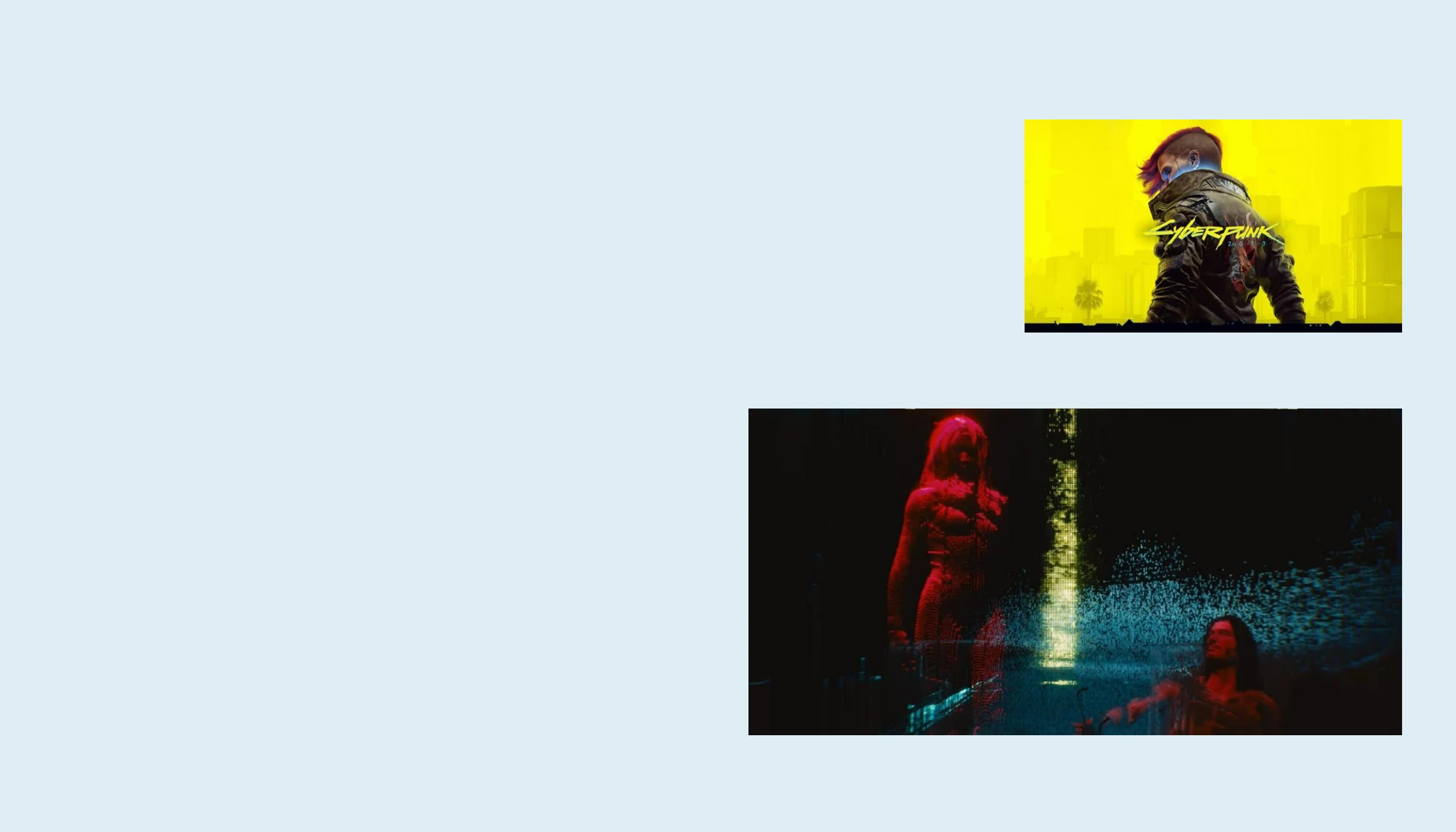
Based on this theme, I thought about a device that may appear in the future, which can automatically generate the user's favorite type of simulated world by reading human consciousness signals. At the same time, I am inspired by games such as Cyberpunk 2077 and I believe that this technology that deeply integrates cyberspace with human consciousness may bring potential danger and chaos. The combination of these factors led me to the inspiration for this game.
Benchmarking
When building the game theme settings, we reviewed the plot in Cyberpunk 2077, where the consciousnesses of V and Silverhand meet in “Mikoshi.” We focused on how to create the blurring effect of cyberspace on human consciousness, so that it is almost difficult for two consciousnesses to distinguish each other. In terms of level and card design, we also studied the mechanics of some existing plot puzzle games and card games to help us set the rules of the game.
The plot and setting of our game revolve around the theme of the game jam "Cloud." We assumed that in the year 2035, the first metaverse application was born. Users only need to imagine the style of the world they want to create in their minds, and the computer can automatically generate the corresponding world based on the interpreted signals of their consciousness. Due to the complexity of the human nervous system and the immature state of technology, users often experience consciousness disarray when attempting to generate a metaverse world through imagination. The user's subconscious and complete consciousness become separated and trapped in cyberspace. The subconscious 'self' has a physical form but has lost all memories, while the complete consciousness 'self' retains full memories but cannot exist physically in the game. Only the subconscious can accurately generate the ideal virtual metaverse. So the goal of the game is that players control the subconscious 'self' and talk with the complete consciousness 'self' to determine the final form of the virtual metaverse, gradually recover complete memories, achieve the fusion of the two consciousnesses, and finally embark on a journey to their ideal virtual world.
Cyber Paradise combines the characteristics of plot puzzles and card games. The player needs to guess the correct answers to the puzzles in the plot based on clues to get different cards, and use the cards at the end of each chapter to pass the level. The choices the player makes in the plot puzzle part will directly affect the type of virtual world the player enters at the end of the game.
Cyber Paradise — Game Mechanics
Game Mechanics
Acquisition of cards:
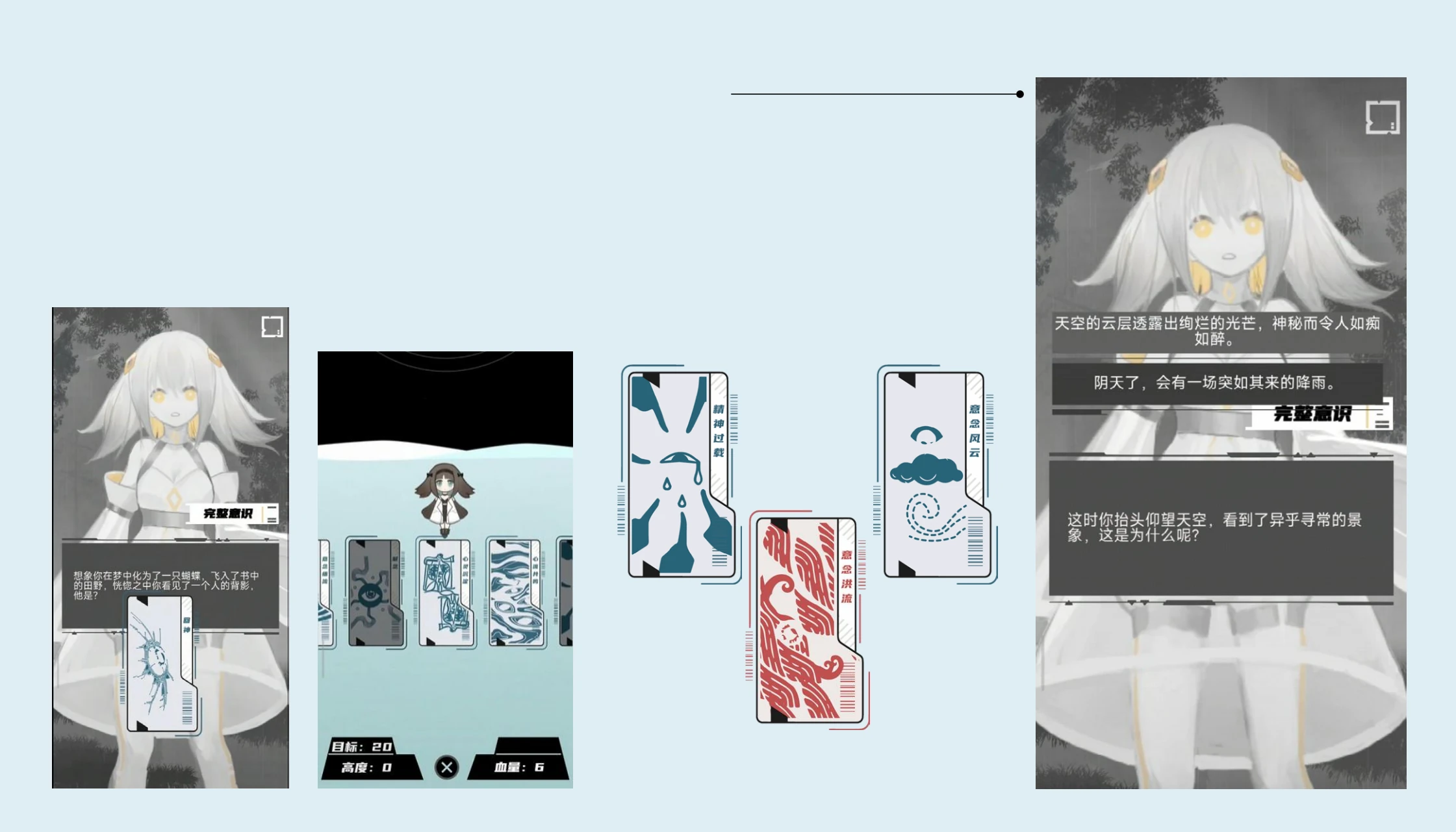
Cards can be obtained by clicking on the keywords in the plot. For example, the following passage: "Imagine you have turned into a butterfly in your dream, flying into the fields within the book. In a daze, you see the back of someone. Who is he?" Keywords such as “butterfly” and “fields” are highlighted. A card called “Consciousness Recovery” is given to the player after clicking on them. Besides, players will also receive corresponding cards when making choices at the end of each plot.
Using cards:
Players have to play a card game after each plot. In each level, the character will start from the bottom and rise, and if he can successfully reach the top, he will pass the level. Each round, the character will rise to a certain height, and the "water of consciousness" around it will also rise to a certain height. If the character rises above the water at the end of a turn, the character takes damage and falls back to the surface. The level fails when the character's health value reaches zero. Players can choose to play specific cards, and different decks will have different effects, such as increasing the rising distance of the water surface, reducing the rising distance of characters, etc. Players need to think carefully about their card strategy to pass the level.
Level Design
Players will make a key choice at the end of each plot.
This choice will affect the type of world that is ultimately generated.
Different choices will also give players different cards. There are 3 such key choices in total, corresponding to eight different world types in the end. Each choice is like selecting one of the two branches at a node in a tree diagram, so the possible endings of the game will gradually narrow down as the plot progresses.
The card deck is also a core part of the level design in this game. Cards are divided into three types: negative cards, ordinary cards, and powerful cards. Negative cards will cause harmful effects to players, while powerful cards have strong positive effects. The use of cards has a cooling time, and only one card can be used per round, so players need to collect as many powerful cards as possible and use them rationally at key moments. Powerful cards have the longest cooldowns, while cards with negative effects have short cooldowns.
Negative card (Mental Overload)
Ordinary Card (Storm of Consciousness)
Powerful Card (Flood of Consciousness)
Cyber Paradise — Art Design, Team and Competition
Art Design
Our Team
The Competition
In order to highlight the chaos and emptiness of cyberspace, I suggested that the artists on the team use a stream-of-consciousness-like art style. This is especially reflected in the design of our cards. We also incorporated some cyber-style visual elements to better reflect the design concept of "cyber cloud".
Play Testing
Due to the very tight competition schedule, we only conducted a brief user test in the last few days. Most players liked the plot design and art style of our game, but some players reported that it was difficult for them to understand the rules and objectives of the game. This made us realize that the game lacked clear guidance for beginners, and we have since made improvements in this area.
Summary
Cyber Paradise brought me many "firsts": my first real game work, my first game jam, my first time developing a game in a team, and so on, so this game means a lot to me. Although this game has many immature aspects, I have accumulated valuable experience from it, such as how to formulate a reasonable game development plan, and it also prompted me to think about some issues. The issue that impressed me most is the relationship between game mechanics and narrative. As the chief designer, I spent a lot of energy on building the plot when designing this game, and ignored the design of gameplay mechanics to a certain extent. Facts have proved that this approach had problems. Later, when I saw discussions about the relationship between game mechanics and game narrative in some professional books, I often thought back to this development experience and reflected on it.
Designer
WANG Ruyue
ZHANG Xunzhuo MOONTAIN V
Programmer
WANG Ruyue
Artist
Li Yuxuan MOONTAIN V
Li Yixing